Saturday, April 27, 2013

Laffer Curve

**higher the tax rate you set, less $ you will collect
**Laffer Curve is controversial and debatable


*trade-off b/t tax rates and govt revenue
*as tax rates ↑ from 0, tax revenues ↑ from 0 to some max level, and then decline
*higher tax rates, less $ you collect
*Criticisms:


  1. where economy is located on curve, it is difficult to determine
  2. tax cuts also ↑ demand which can fuel inflation
  3. empirical evidence suggests that impact on tax rates on incentives to work, save, and invest are small


Friday, April 26, 2013

Phillips Curve Cont.

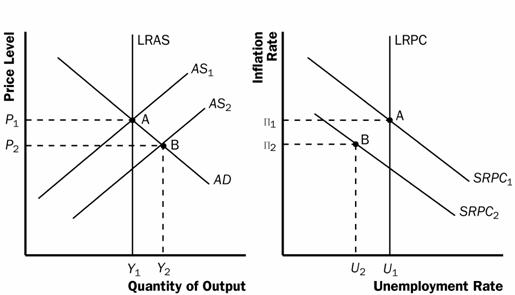
SRAS→=SRPC←
(imagine the direction of the arrows on the corresponding graphs below)

  • inflationary expectations ↓, input prices ↓, productivity ↑, business taxes ↓, +/or deregulation
  • SRAS→: GDPR↑ and PL ↓; u%↓ and π%↓
  • SRPC← (disinflation)
 *supply shock→rapid and significant increase in resource cost which causes the SRAS to shift
*NRU→is = to frictional, structural, and seasonal (cyclical based on economy)
  • natural rates and fewer worker benefits create a lower NRU (free med. care for all workers, lay-off some b/c profits being eaten)
*misery index→combo. of inflation (2-3%) and unemployment (double digits=depression, forget a recession) in any given year. Single digit misery is good. 
*if inflation rate persists and expected rate of unemployment rises, then entire SRPC moves upward. When that happens, stagflation exists. 
*if inflation expectations drop (due to new tech., efficiency, etc.), the SRPC moves downward

*stagflation→↑ unemployment and ↑inflation occurring at same time
*disinflation→when inflation decreases over time 
  • nominal wages ↓ (good)
  • business profits fall as prices ↑ (bad)
  • firms reduce employment, thus, unemployment ↑

Unit VI: The Phillips Curve

u%=unemployment rate
π%=rate of inflation


*The Phillips Curve represents the relationship b/t unemployment and inflation
*trade-off b/t unemployment and inflation occurs over SR
*each point on the Phillips Curve corresponds to a different level of output
*LRPC=long run Phillips Curve
  • occurs at NRU
  • represented by ↨ line
  • no trade-off b/t unemployment and inflation in LR
  1. economy produces @ FE output level
  2. nominal wages of workers fully incorporates any changes in PL as wages adjust to inflation over the LR
*LRPC only shifts when LRAS shifts (both have the same determinants)
*↑ in unemployment, LRPC →
*↓ in unemployment, LRPC ←
*Increase in AD=up/left movement along SRPC 

  • C↑, Ig↑, G↑, and/or Xn↑
  • AD→: GDPR↑ and PL ↑; u%↓ and π%↑; up/left along SRPC
  • this would be depicted in the graph below 
*Decrease in AD=down/right along SRPC
  • C↓, Ig↓, G↓, and/or Xn↓
  • AD←: GDPR↓ and PL↓; u%↑ and π%↓; down/right along SRPC
  • in this case, point B would move to point A in the graph below


**Check out this blog for more info. on the Phillips Curve and other economic topics: http://macroeconomic1.wordpress.com/ 

Unit V: AD/AS: From SR to LR

*AS curve doesn't shift in response to changes in the AD curve in the short run

  • i.e.-nominal wages do not respond to PL changes
  • workers may not realize impact of the changes or may be under contract (i.e. teachers don't get paid more for tutorials)
*Long run (vertical)-prd in which nominal wages are fully responsive to previous changes in PL

*when changes occur in the SR, they result in either increased/decreased producer profits-not changes in wages paid
*in the LR, increases in AD result in a higher PL. As in SR, but as workers demand more $, the AS curve shifts left to equate production @ the original output level, but now @ a higher price. 
*in the LR, the AS curve is vertical (LRAS) @ the natural rate of unemployment (NRU), or FE level of output. Everyone who wants a job has one and no one is enticed (lured or tempted) into or out of market.
*Demand-pull inflation will result when an increase in demand shifts the AD curve to →, temporarily increasing output while raising prices. 
*Cost-push inflation results when an increase in input costs that shifts the AS curve to ←. In this case, the PL increase is not in response to ↑ in AD, but instead the cause of PL increasing. (in a recession, AD ↓ and shifts ←)

Sunday, April 14, 2013

Graph: Crowding Out


Monetary & Fiscal Policy (during a recession)


Monetary Policy
(Recession)
International Trade
Fed will:
      1.       Buy bonds                
      2.       Lower RR                
      3.       Lower DR
      4.       Lower FF

 all contribute to:
MS ↑, i ↓, Ig ↑, AD ↑,
GDP ↑


**opposite occurs during inflationary prd
D $ (demand for $) ↓
$ depreciated (value of $ goes ↓)
Exports ↑ (cheaper)
Xn ↑
AD ↑
GDP ↑


Fiscal Policy
(Recession)
International Trade
-congress will cut taxes or ↑ govt spending
-consumption and govt spending will ↑
-AD will ↑
-GDP ↑
-Deficit→supply of LF ↓ (none to loan out)
I (interest) ↑
Ig ↓
D $ ↑
$ appreciate (increase in value)
Exports ↓
Net exports ↓
AD ↓
GDP ↓

Wednesday, April 10, 2013

Loanable Funds Market

Loanable Funds Market (LF)→market where savers and borrowers exchange funds (QLF) @ real rate of interest (r%)
  • D for LF, or borrowing comes form households, firms, govt, and foreign sector. DLF is supply of bonds
  • SLF, or savings comes from households, firms, govt, and foreign sector. SLF also demand for bonds. 
Changes in DLF:
  • more borrowing=more demand for LF (→)
  • less borrowing=less demand for LF (←)
EX) Govt deficit spending=more borrowing
  • =more DLF (DLF→, r% ↑) 
 less investment demand=less borrowing
  • less DLF (DLF ←, r% ↓)
Changes in SLF:
  • more saving=more SLF (→)
  • less saving=less SLF (←)
EX) Govt budget surplus=more saving
  • more SLF (SLF →, r% ↓)
Decrease in consumer's MPS=less saving
  • less SLF (SLF ←, r% ↑)